csdmpy:doc v0.7.0
  • Table Of Contents
      • Example Gallery
        • Scalar, 1D{1} datasets
        • Scalar, 2D{1} datasets
        • Vector datasets
        • Tensor datasets
        • Pixel datasets
        • Correlated datasets
        • Sparse datasets
  • previous
  • next
  • index
  • Show Source

Logo

Quick search

Enter search terms or a module, class or function name.

Table of Contents

  • Introduction to CSDM format
  • Installation
  • Getting started with csdmpy package
  • Example Gallery
    • Scalar, 1D{1} datasets
    • Scalar, 2D{1} datasets
    • Vector datasets
    • Tensor datasets
    • Pixel datasets
    • Correlated datasets
    • Sparse datasets
  • Serializing CSDM object to file
  • Using csdmpy objects
  • Interacting with csdmpy objects
  • Plotting CSDM object with matplotlib
  • Tutorial examples on generating CSDM datasets
  • An emoji 😁 example
  • API-Reference
  • Changelog

Example Gallery

In this section, we present illustrative examples for importing files serialized with the CSD model, using the csdmpy package. Because the CSD model allows multi-dimensional datasets with multiple dependent variables, we use a shorthand notation of \(d\mathrm{D}\{p\}\) to indicate that a dataset has a \(p\)-component dependent variable defined on a \(d\)-dimensional coordinate grid. In the case of correlated datasets, the number of components in each dependent variable is given as a list within the curly braces, i.e., \(d\mathrm{D}\{p_0, p_1, p_2, ...\}\).

Scalar, 1D{1} datasets

The 1D{1} datasets are one dimensional, \(d=1\), with one single-component, \(p=1\), dependent variable. These datasets are the most common, and we, therefore, provide a few examples from various fields of science.
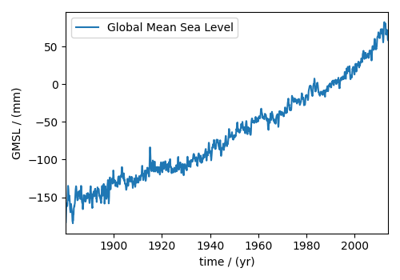
Global Mean Sea Level rise dataset

Global Mean Sea Level rise dataset

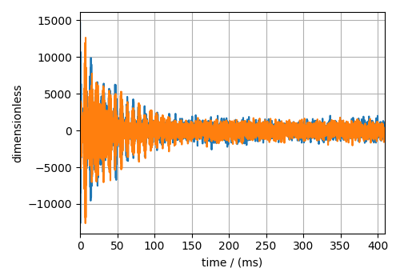
Nuclear Magnetic Resonance (NMR) dataset

Nuclear Magnetic Resonance (NMR) dataset

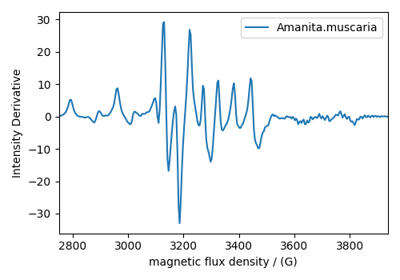
Electron Paramagnetic Resonance (EPR) dataset

Electron Paramagnetic Resonance (EPR) dataset

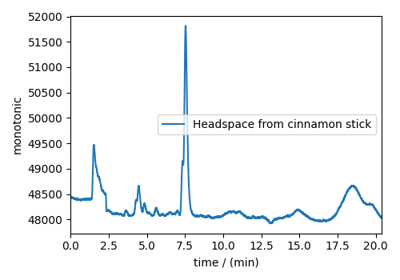
Gas Chromatography dataset

Gas Chromatography dataset

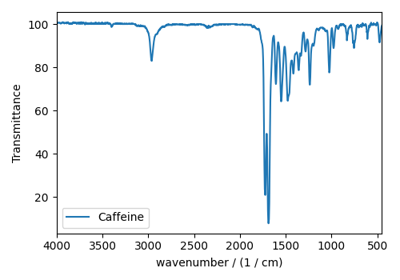
Fourier Transform Infrared Spectroscopy (FTIR) dataset
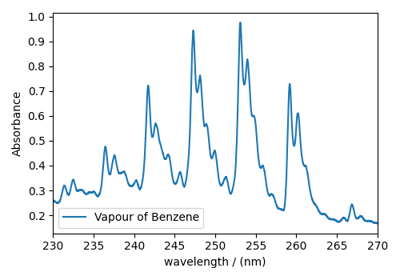
Fourier Transform Infrared Spectroscopy (FTIR) dataset
Ultraviolet–visible (UV-vis) dataset

Ultraviolet–visible (UV-vis) dataset

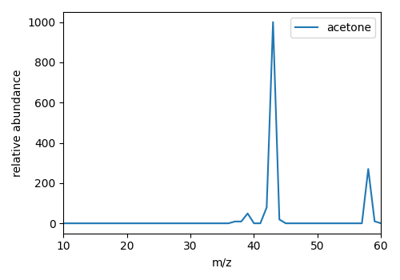
Mass spectrometry (sparse) dataset

Mass spectrometry (sparse) dataset

Scalar, 2D{1} datasets

The 2D{1} datasets are two dimensional, \(d=2\), with one single-component dependent variable, \(p=1\). Following are some 2D{1} example datasets from various scientific fields expressed in CSDM format.
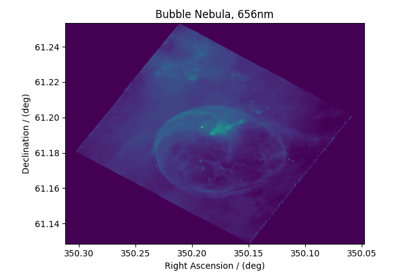
Astronomy dataset

Astronomy dataset

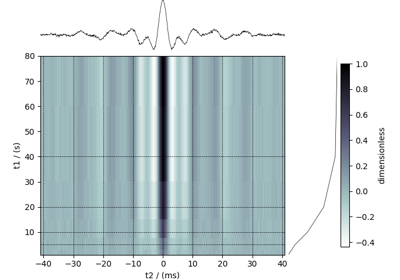
Nuclear Magnetic Resonance (NMR) dataset

Nuclear Magnetic Resonance (NMR) dataset

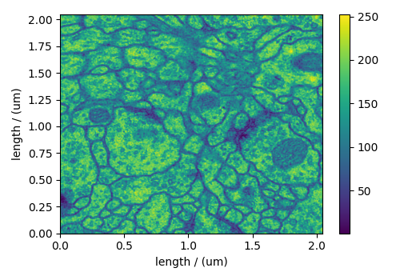
Transmission Electron Microscopy (TEM) dataset

Transmission Electron Microscopy (TEM) dataset

Labeled Dataset

Labeled Dataset

Vector datasets

Vector, 1D{2} dataset

Vector, 1D{2} dataset

Vector, 2D{2} dataset

Vector, 2D{2} dataset

Tensor datasets

Diffusion tensor MRI, 3D{6} dataset

Diffusion tensor MRI, 3D{6} dataset

Pixel datasets

Image, 2D{3} datasets

Image, 2D{3} datasets

Correlated datasets

The Core Scientific Dataset Model (CSDM) supports multiple dependent variables that share the same d-dimensional coordinate grid, where \(d>=0\). We call the dependent variables from these datasets as correlated datasets. Following are a few examples of the correlated dataset.
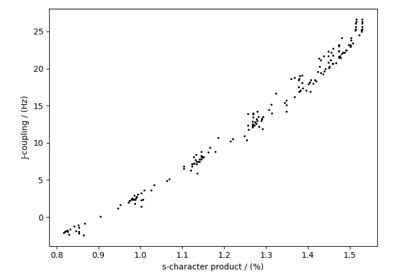
Scatter, 0D{1,1} dataset

Scatter, 0D{1,1} dataset

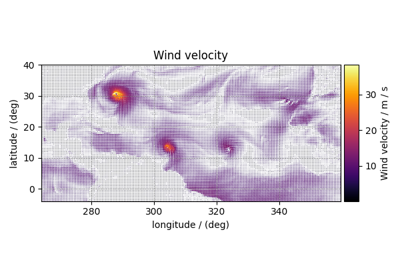
Meteorological, 2D{1,1,2,1,1} dataset

Meteorological, 2D{1,1,2,1,1} dataset

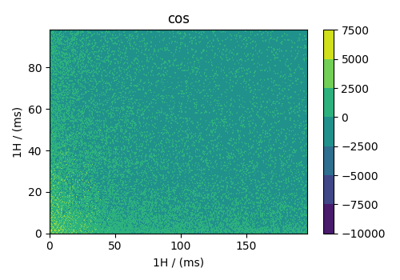
Astronomy, 2D{1,1,1} dataset (Creating image composition)
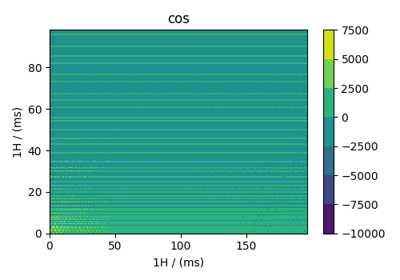
Astronomy, 2D{1,1,1} dataset (Creating image composition)
Sparse datasets

Sparse along one dimension, 2D{1,1} dataset

Sparse along one dimension, 2D{1,1} dataset

Sparse along two dimensions, 2D{1,1} dataset

Sparse along two dimensions, 2D{1,1} dataset

Download all examples in Python source code: auto_examples_python.zip

Download all examples in Jupyter notebooks: auto_examples_jupyter.zip

Gallery generated by Sphinx-Gallery

Page Source   Back to Top

© Copyright 2019-2024, Deepansh J. Srivastava.
Created using Sphinx 5.3.0.   Last built Oct 27, 2024.